
Assessment of Cervical Cancer Prevention Practice among Female Health Workers at a Level Three Hospital in Port Harcourt, Nigeria
Keywords:
Port Harcourt, Health care providers, Pap Smear, Uptake, HPV vaccineAbstract
Background: Cervical cancer though a preventable malignancy is still prevalent in sub-Saharan African and the Human Papillomavirus is recognized as the principal causative agent. Preventive measures have been known to be effective and are provided by healthcare workers.
Objective: To determine the uptake of Human Papillomavirus vaccination and Papanicolaou Smear among female health workers at the University of Port Harcourt Teaching Hospital.
Methods: This was a cross-sectional study to determine the uptake of the Human Papillomavirus vaccine and Papanicolaou smear among female healthcare providers. A self-administered questionnaire was used to obtain relevant information from consenting respondents from the major departments in the hospital. Data obtained were entered and analyzed using SPSS version 21 software package.
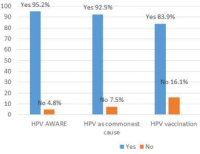
Results: The uptake of Human Papillomavirus vaccine was 2.2% with only 11.3% been screened for cervical cancer by Pap smear. Three hundred and fty-four 95.2%) had good knowledge of Human Papillomavirus vaccine, and 83.1% were aware of the vaccine. The high cost (45.1%) and inability to access (42.1%) the vaccine were the main reasons for the poor uptake of the vaccine. Three hundred and forty-two (94.0%) were willing to take the vaccine if available and affordable.
Conclusion: This study demonstrated a considerable disparity between knowledge and uptake of the Human Papillomavirus vaccine. The low participation in self prevention of cervical cancer may send wrong signals to the general populace, hence reduce community participation. The government at all levels should formulate programmes to ensure availability and utilization of Human Papillomavirus vaccine
Downloads
References
(1) Walboomers JM1, Jacobs MV, Manos MM, Bosch FX, Kummer JA, Shah KV et al. Human papillomavirus is a necessary cause of invasive cervical cancer worldwide. J Pathol. 1999 ;189(1):12-9.
(2) Di Gusseppe G, Abbate R, Liguiri G, Albano L, Angelillo IF. Human papilloma virus and vaccination knowledge, attitude and behavioral
intension in adolescents and young women in Italy. Br J Cancer 2008; 99(2):225-9.
(3) Parkin DM, Bary FL, Devesa SS. Cancer burden in 2000: the global picture. Eur J Cancer 2001:37 (suppl 8) S4- 66.
(4)Lowndes CM. Editorial review. Vaccines for cervical cancer. Epidemiol. Infect 2006; 134:1-12
(5)Bosch FX, Lorinez A, Munos N, Meijer CJ, Shah KV. The causal relation between human papilloma virus and cervical cancer. J Clin
Pathol. 2002; 55:244-65
(6)Trim K, Nagji N, Elit L, Roy K. Parent knowledge, attitude and behavior towards human papilloma virus vaccination for their children: a systemic review from 2001 to 2011.Obstet Gynecol Int. 2012; 2012: 921236. doi: 10.1155/2012/921236
(7)Dahlstrom LA, Tran TN, L Lundholm C, Young C, Sundstrom K. Attitude to HPV vaccination among parents of children aged 12-15 years. A Populationbased survey in Sudan. Int J Cancer 2010;126(2):500-7
(8)Anorlu RL. Cervical cancer: the sub –Saharan African perspective. Reprod Health Matters 2008;16(32):41-9.
(9)Burk RD, Kelly P, Feldman J, Bromberg J, Vermund SH, DeHovitz JA et al. Declining prevalence of cervicovaginal human papillomavirus infection with age is independent of other risk factors. Sex Transm Dis. 1996;23(4):333-41
(10) World health organization information centre on HPV and cervical cancers in Nigeria. Summary report 2010. www.HPVcentre.Net/report/NGA
(11) Bosch FX, Manos MM, Munoz N, Sherman M, Jansen AM, Peto J et all. Prevalence of human papillomavirus in cervical cancer: A worldwide perspective. International biological study on cervical cancer (IBSCC) study group. J Nat L cancer Inst 1995; 87:796-802
(12) Smith JS, Lindsay L, Hoots B, Franceschi S, Winer R, Clifford GM. Human papilloma virus type distribution on invasive cervical cancer and high-grade cervical lesions: A meta-analysis update. Intl J Cancer 2007; 121:621-32
(13) UICC calls for coordinated action against infections that contribute to global cancer burden (press release). Lyon France: International Agency for research on cancer (IARC), World health organization, February 4, 2010
(14) Clifford G, Francechis S, Diaz M, Munos M, Villa LL. Chapter 3: HPV type distribution in women with and without cervical neoplastic disease. Vaccine 2006; 24:26-34.
(15) Smith SJ, Lyndsay L, Hoots B. Human papilloma virus type distribution in invasive cervical cancer and high-grade cervical lesions: a meta-analysis update. International Journal of disease 2007; 121:621-32
(16) Ault KA, Future 11 study group. Effect of prophylactic human papilloma virus, virus-like particle vaccine on risk of cervical intraepithelial neoplasia grade 2, grade 3 and adenocarcinoma in situ. A combined analysis of four randomized clinical trials. The lancet 2007;369(9576): 1861-8.
(17) Paavonen J, Naud P, Salmcron J. virus (HPV) -16 and 18 ASO 4 adjuvanted vaccine against cervical infection and precancer caused by oncogenic HPV (PATRICIA): nal analysis of a double-blind, randomized study in young women. The lancet 2009;374(15)308-14
(18) WHO. Human papilloma virus vaccine: WHO position paper weekly epidemiological record 2009;84(15):118-31.
(19) Sera EC, Paula CB, Rachel M, Leach M, Paul T. Healthcare providers perspective on the acceptability and uptake of HPV vaccines in
Zimbabwe. Journal of Obstetrics and Gynaecology 2016;(37):147- 155.
(20) Remes P, Selestine V, Changalucha J, Ross DA, Wight D , Silvia de S et al. A qualitative study of HPV vaccine acceptability among
health workers, teachers, parents, female pupils and religious leaders in North-West Tanzania. Vaccine 2012:30(36):5363-7
(21) Catherine MC, David P, Pierre MT, Michel B, Anderson SD. Awareness of HPV and cervical cancer prevention among Cameroonian healthcare workers. BMC women`s health 2011,11:45. doi 1186/1472-6874- 11-45
(22) Ugwu EO, Obi SN, Ezechukwu pc, Okafor II, Ugwu AO. Acceptability of human papillomavirus vaccines and cervical cancer screening among health care workers in Enugu, South- East, Nigeria. Niger J Clin Pract. 2013;16(2):249-52
(23) Mahajan BK. In: Mahajan BK (ed). Methods in Biostatistics for 15 Medical students and Research workers. 6th edition, New Delhi, Jaypee Brothers Med Publishers ltd 1997;88-102.
(24) James O'Donovan, Charles O'Donovan, Shobhana Nagraj.The role of community health workers in cervical cancer screening in low income and middle-income countries: a systematic scoping review of the literature. BMJ Global Health 2019; 4(3): e001452.
(25) Dim CC. Towards improving cervical cancer screening in Nigeria: A review of the basics of cervical neoplasm and cytology, Niger J Clin Pract, 2012; 15 (3): 247-252
(26) Ezem, B. U. Awareness and Uptake of cervical cancer in Owerri, SouthEast Nigeria. Ann Afri Med.2007; 6 (3):84-8
(27) McCarey C, Pirek D, Tebeu PM, Boulvain M, Doh AS, Petignat P. Awareness of HPV and cervical cancer prevention among Cameroonian Health Workers. BMC Women's Health 11(45). Http ://doi.org/10.1186/1472-6874-11-45.
(28) Diani YT, Panozzo CA, RamogolaMasire D, Steinhoff AP. A crosssectional study of HPV vaccine acceptability in Gaborone Botswana. Plus
ONE.2011;6(10):25481
(29) Kristina T, Naushin N, Laurie E, Katherine R. Parental knowledge, attitude andbehaviours towards Human papilloma virus vaccination for
their children: A systemic review from 2001 to 2011.Obstet Gynaecolint.2012;2012:921236
(30)Patel H, Pcolkina K, Strazdina K, Viberga I, Sherman SM, Tincello DG et al. Awareness of HPV infection and altitudes towards
HPV vaccination among Latvian adolescents. Int J Gynecol Obstet 2017;137(2):138-144
(31) Iwegbe OA, Ugboaja OJ, Monago NE. Prevalence and determinants of unmet need for family planning in Nnewi, South-east Nigeria.
International journal of medicine and medical sciences 2009;1(8):325- 329
(32)Urassa W, Moshiro C, Chalamalilla F, Mhalu ES. Risky sexual practices among youth attending a sexually transmitted infection
clinic in Des es Salaam, Tanzania. BMC infectious disease.2008;8(1):159
(33)Lam JU1, Rebolj M, Dugué PA, Bonde J, von Euler-Chelpin M, Lynge E.Condom use in prevention of Human Papillomavirus infections and cervical neoplasia: systematic review of longitudinal studies. J Med Screen. 2014;21(1):38-50 (34)Sylvia BD, Walter AO, Noel TB, Keawango A, Smith JS. HPV vaccine acceptability among Kenyan women. Vaccine 2010;28(31):4864-4867.
(35)Paljak M. Prophylactic human papillomavirus vaccination and primary prevention of cervical cancer: issues and challenges.
Clin Microbiol Infect 2012;18(5):64- 69
(36)Widgren K, Simonsen J, Valentinerbranth P, Molbak K. Uptake of human papilloma virus–vaccination within the free-ofcharge children vaccination program in Denmark. Vaccine 2011; 29:9663-9667. Efficacy of human papilloma
Downloads
Published
Issue
Section
License
All articles published in the journal are licensed under a Creative Commons Attribution (CC BY) license(i.e CC Attribution-NonCommercial-ShareAlike 4.0), allowing others to share, distribute, and build upon the work, provided the original author(s) and source are properly cited. Authors retain the copyright of their work.

